

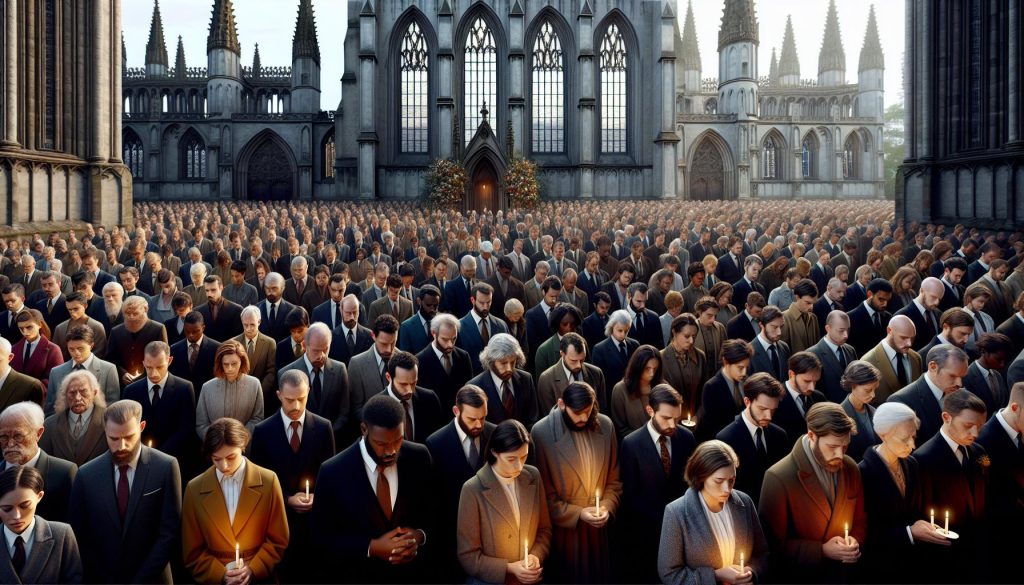
When we lose someone we love, the pain can feel overwhelming. In those moments, many of us find comfort in the age-old tradition of praying for the dead. It’s a way to connect with our loved ones, offering a sense of peace and closure.
Prayer for the dead isn’t just about mourning; it’s about celebrating their lives and ensuring their spirits find rest. Whether it’s through quiet reflection or communal ceremonies, these prayers help us navigate our grief and honor those we’ve lost. Let’s explore how this practice brings solace and unity to our lives.
Proclamation Prayer for the Dead
Heavenly Father,
I come before You today with a humble heart, lifting up the soul of [Name] who has departed from this world. I trust in Your infinite mercy and love, and I proclaim Your Word over their life, asking for Your peace and eternal rest to be granted to them.
As it is written in John 11:25-26, “Jesus said to her, ‘I am the resurrection and the life. Whoever believes in Me, though he die, yet shall he live, and everyone who lives and believes in Me shall never die.'” I proclaim this truth over [Name]. Lord, in Your mercy, grant them eternal life in Your presence. Let their faith in You bring them into the fullness of Your eternal kingdom, where death has no power.
Your Word in Psalm 23:4 assures us, “Even though I walk through the valley of the shadow of death, I will fear no evil, for You are with me; Your rod and Your staff, they comfort me.” I declare this over [Name]. As they walked through the valley of death, may Your presence have comforted them. Let Your peace now surround them, and may they rest in Your everlasting arms.
In 2 Corinthians 5:8, it is written, “We are confident, yes, well pleased rather to be absent from the body and to be present with the Lord.” I proclaim this promise over [Name]. May they now be in Your glorious presence, free from pain, sorrow, and suffering. Let them experience the fullness of joy that comes from being with You, Lord.
Father, Your Word in Revelation 21:4 says, “He will wipe away every tear from their eyes, and death shall be no more, neither shall there be mourning, nor crying, nor pain anymore, for the former things have passed away.” I declare this promise over [Name]. Wipe away every tear, and let them enter into the new life You have prepared, where there is no more pain or mourning—only peace and eternal joy.
In Romans 14:8, Your Word reminds us, “For if we live, we live to the Lord, and if we die, we die to the Lord. So then, whether we live or whether we die, we are the Lord’s.” I proclaim this over [Name]. Whether in life or death, they belong to You, Lord. I trust that You have received them into Your care and that they are now with You in peace.
Lord, I stand on the promise of 1 Thessalonians 4:14, “For since we believe that Jesus died and rose again, even so, through Jesus, God will bring with Him those who have fallen asleep.” I proclaim this truth over [Name]. Let the hope of resurrection bring comfort, knowing that they will rise again in Christ and share in the victory over death.
Your Word in Isaiah 57:2 offers this comfort: “Those who walk uprightly enter into peace; they find rest as they lie in death.” I declare this over [Name]. May they now enter into Your peace and find rest in You. Let their soul be at peace in Your presence, free from all earthly burdens.
In Psalm 116:15, it is written, “Precious in the sight of the Lord is the death of His saints.” I proclaim this over [Name]. Their life and their passing are precious in Your sight, Lord. May they be welcomed into Your kingdom with love and grace, and may their soul find eternal rest in You.
Finally, Father, I echo the words of Jude 1:24-25, “Now to Him who is able to keep you from stumbling and to present you blameless before the presence of His glory with great joy, to the only God, our Savior, through Jesus Christ our Lord, be glory, majesty, dominion, and authority, before all time and now and forever. Amen.” I entrust [Name] into Your loving care, believing that You will present them blameless before Your glorious presence, filled with joy and peace.
Thank You, Lord, for Your mercy and the hope of eternal life. I trust in Your promises and ask that You grant [Name] eternal rest and peace in Your heavenly kingdom.
I pray this in the name of Jesus Christ, our Lord and Savior. Amen.
Catholic Prayers for the Dead
here are several traditional Catholic prayers for the dead that have been used for centuries. These prayers are often recited during funerals, memorial services, or in personal devotion for the repose of the souls of the deceased. Here are a few of the most common traditional Catholic prayers for the dead:
1. Eternal Rest Prayer
This is one of the most well-known prayers for the deceased.
Prayer:
“Eternal rest grant unto them, O Lord,
and let perpetual light shine upon them.
May their souls and the souls of all the faithful departed,
through the mercy of God, rest in peace. Amen.”
2. The Requiem Aeternam
This is another version of the Eternal Rest Prayer, often used in the context of the Mass for the Dead.
Prayer:
“Requiem aeternam dona eis, Domine,
et lux perpetua luceat eis.
Requiescant in pace. Amen.”
(Translation: Eternal rest grant unto them, O Lord, and let perpetual light shine upon them. May they rest in peace. Amen.)
3. The De Profundis (Psalm 130)
This psalm is traditionally recited for the dead and is part of the Church’s official prayers for the deceased.
Prayer:
“Out of the depths I cry to you, O Lord;
Lord, hear my voice!
Let your ears be attentive
to my voice in supplication:
If you, O Lord, mark iniquities,
Lord, who can stand?
But with you is forgiveness,
that you may be revered.
I trust in the Lord;
my soul trusts in his word.
My soul waits for the Lord
more than sentinels wait for the dawn.
More than sentinels wait for the dawn,
let Israel wait for the Lord,
For with the Lord is kindness,
and with him is plenteous redemption;
And he will redeem Israel
from all their iniquities.”
4. The Prayer of Commendation
This prayer is typically said when a person is near death, but it is also appropriate as a prayer for the deceased.
Prayer:
*”Go forth, Christian soul, from this world
in the name of God the almighty Father,
who created you,
in the name of Jesus Christ,
the Son of the living God,
who suffered for you,
in the name of the Holy Spirit,
who was poured out upon you,
Go forth, faithful Christian.
May you live in peace this day,
may your home be with God in Zion,
with Mary, the virgin Mother of God,
with Joseph, and all the angels and saints…”*
5. The Litany for the Faithful Departed
This is a longer prayer, often used during All Souls’ Day or at other times when the faithful are remembered.
Prayer:
*”Lord, have mercy on us.
Christ, have mercy on us.
Lord, have mercy on us.
Christ, hear us.
Christ, graciously hear us.
God the Father of Heaven,
have mercy on the souls of the faithful departed.
God the Son, Redeemer of the world,
have mercy on the souls of the faithful departed.
God the Holy Spirit,
have mercy on the souls of the faithful departed.
Holy Trinity, one God,
have mercy on the souls of the faithful departed.
Holy Mary, Mother of God,
pray for the souls of the faithful departed.
Saint Michael,
pray for the souls of the faithful departed.
All you angels and archangels,
pray for the souls of the faithful departed.
All you orders of blessed spirits,
pray for the souls of the faithful departed…
(Additional invocations continue, and the prayer typically concludes with:)
Eternal rest grant unto them, O Lord,
and let perpetual light shine upon them.
May they rest in peace. Amen.”*
These prayers reflect the Catholic Church’s belief in the communion of saints, the mercy of God, and the hope of eternal life. They are meant to intercede for the souls of the deceased, asking God to forgive their sins and bring them into the joy of His presence.
Historical Origins of Prayer for the Dead
Jewish Roots
In the Jewish tradition, prayer for the dead dates back to the book of 2 Maccabees (12:39–45). Here, Judas Maccabeus and his men pray for forgiveness for their fallen comrades who wore pagan amulets. This passage offers a clear example of prayer for the dead in a Jewish context. We can see how this ritual began as a way to seek mercy and pardon for those who had passed away.
Early Christianity
In early Christianity, prayer for the dead was common. The New Testament in 2 Timothy 1:16–18 is viewed by some as a prayer for the dead, where Paul prays for the household of Onesiphorus, who had died. Early Church Fathers, like Tertullian († 230), also mention prayers for the dead in their writings. These references illustrate the continuation and adoption of this practice within the Christian faith.
By integrating prayers with biblical verses, like in these early examples, we connect deeply with historical traditions while offering comfort and seeking solace for those who have departed.
Religious Perspectives
Different religions view praying for the dead in unique ways. Let’s explore a few perspectives.
Christianity
In Christianity, particularly in Catholic and Eastern Orthodox traditions, the belief is that our prayers can help the deceased on their journey toward heaven. The Catholic Church teaches that souls undergo purification in purgatory before entering heaven. By praying for the dead, we can hasten this process. Examples include offering masses or specific prayers. Eastern Orthodox Christians also value prayers for the deceased, comforting the grieving and aiding the departed in their afterlife journey.
Cultural Traditions
Praying for the dead is a practice rooted in both Western and Eastern traditions. It’s a way for us to connect with our deceased loved ones and offer them peace.
Western Practices
Catholicism
Prayers for the dead are central in Catholicism, especially on All Souls’ Day (November 2nd). For centuries, Catholics believe that our prayers can help the deceased, particularly through the Mass and other devotions. This same principle of spiritual intercession can be seen in how believers pray to overcome everyday challenges, including prayers against business bewitchment, failure, and stagnation, entrusting every life area—temporal and eternal—into God’s hands. The Catholic Church teaches that through prayer and the sacrifice of the Mass, the dead can be purified and attain heaven.
Protestantism
In Protestantism, there’s no unified stance on praying for the dead. But, denominations like the Anglican and Lutheran churches maintain prayers for the dead, especially during funeral services. These prayers aim to honor the deceased and seek comfort for the living.
Psychological and Social Impacts
Prayer for the dead offers numerous psychological and social benefits. It’s not just a ritual but a meaningful practice that aids in grief and healing while strengthening community bonds.
Grief and Healing
Engaging in prayer for the dead helps many of us cope with loss. It’s a powerful coping mechanism, allowing us to process our emotions and connect with deceased loved ones. According to the Journal of Loss and Trauma (2018), this practice provides emotional comfort and helps individuals find meaning in their loss.
For those grieving, prayer can be a source of significant solace, guiding us through tough times. Praying Scriptures like Psalm 34:18, “The Lord is close to the brokenhearted and saves those who are crushed in spirit,” can bring peace and reassurance.
Community and Memory
Group prayers and communal rituals play a vital role in our lives. They foster social support among mourners, reducing feelings of isolation. In times of loss, joining in heartfelt prayer points for the church can uplift not only our individual spirits but also strengthen the collective faith of the entire body of Christ.
By coming together, we strengthen community bonds and create a lasting memory of the departed. For example, participating in a community prayer event provides a sense of belonging and shared purpose, helping us all remember and honor our loved ones.
Controversies and Debates
Prayer for the dead sparks significant debate in various Christian communities. Key issues revolve around the effectiveness of prayer and theological interpretations of purgatory and judgment.
Effectiveness of Prayer
The effectiveness of praying for the dead is contested. Some argue it’s futile, claiming their fate has already been decided. Others believe that no prayer is wasted and that God can use present prayers to affect the past. The Catholic Church upholds that prayers can benefit souls in purgatory, reducing their time of purification.
Purgatory and Judgment
The concept of purgatory is central to these debates. Catholics maintain that souls in purgatory gain from prayers, but other denominations question this, arguing that if the dead are already judged, prayers can’t alter their fate. This leads to discussions on whether there are multiple judgments—one immediately after death and another on Judgment Day—and what role, if any, prayer plays in this process.
Key Takeaways
- Historical Origins: Praying for the dead has deep historical roots in Jewish and early Christian traditions, providing a foundation for the practice across various faiths.
- Religious Perspectives: Different religions, such as Christianity, Islam, Judaism, Hinduism, and Buddhism, have unique views and rituals for praying for the deceased, reflecting their beliefs about the afterlife and the soul’s journey.
- Cultural Traditions: Both Western and Eastern traditions incorporate prayers for the dead, offering peace to the deceased and comforting the living through ceremonies and communal practices.
- Psychological and Social Impacts: The practice of praying for the dead helps with grief and healing, providing emotional comfort and strengthening community bonds, fostering a sense of collective memory and support.
- Controversies and Debates: The effectiveness and theological implications of praying for the dead, including concepts like purgatory and judgment, spark significant debate within various Christian communities.
Praying for the dead is a deeply rooted tradition that varies across cultures and religions. It helps us cope with grief, brings communities together, and offers comfort in times of loss. Whether we believe in its spiritual efficacy or see it as a way to honor those who’ve passed, these practices have a profound impact on our lives. By engaging in these rituals, we not only remember our loved ones but also find strength and support in our shared experiences.
